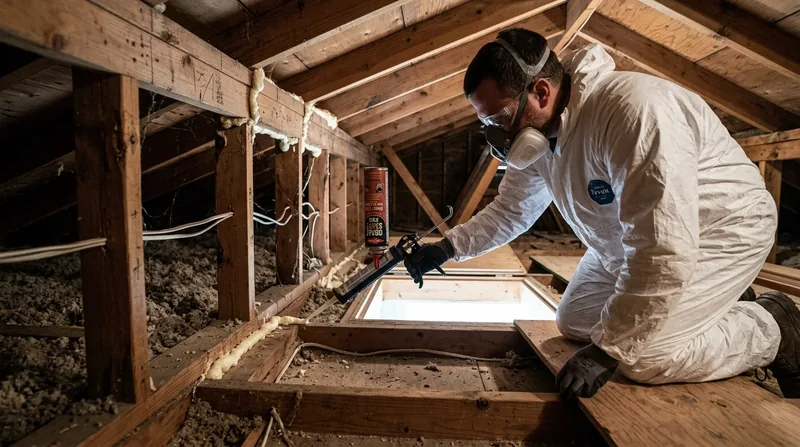




Stack effect pulls heated air up and out of Sioux Falls homes all winter, and sealing gaps slows that loss. Air sealing in Sioux Falls addresses the single biggest source of energy waste in the homes across Minnehaha and Lincoln counties: infiltration through top plates, rim joists, band joists, and penetrations where utilities enter walls. The long heating season here, combined with the pressure differences that stack effect creates, means a basement rim joist can leak as much warm air as a poorly insulated attic. We find and close these leaks so basements stay warmer, attics stay drier, and your heating system runs fewer cycles. Unlike fiberglass, which does nothing to stop air movement, spray foam seals the gaps where the air actually escapes. That is the difference between insulation that slows heat transfer and air sealing that stops infiltration altogether.
Why Air Sealing Matters in Sioux Falls Homes
Sioux Falls sits in IECC climate zone 6A, where outdoor temperatures drop to 20 below zero and stay there for weeks at a time. That cold air finds every gap in your building envelope, and stack effect accelerates the escape. A 1950s ranch with a full basement and an unvented attic loses heated air at the rim joist while cold air gets pulled in at the basement band. A two-story home over a garage in Tea or Brandon experiences the same pressure, magnified by the height difference. The dew point inside wall cavities and rim joists becomes a real concern through the coldest months, so air sealing is not optional here; it is a structural and energy necessity.
- Reduces stack effect losses by sealing the rim joist and band joist where cold basements pull the most heated air downward and out.
- Prevents moisture from being driven outward into cold attics and wall cavities during the long heating season.
- Lowers heating bills by stopping infiltration, which costs more to condition than conduction through insulation alone.
- Stabilizes basement temperatures in homes across Sioux Falls, Brandon, and Harrisburg where full basements sit below living spaces.
- Protects spray foam insulation work by sealing the gaps that fiberglass alone cannot address.
Air sealing is the foundation of any retrofit or new construction insulation job; without it, even high-R foam is fighting a losing battle against infiltration.
Key info: A 1970s split-level in Sioux Falls with a rim joist gap of just one inch running the full perimeter of the basement can lose as much heated air in January as an uninsulated 4x4 foot attic opening. Sealing that gap with closed cell foam stops the loss immediately.
For more on how spray foam insulation complements air sealing, see our closed cell spray foam insulation page.
How We Perform Air Sealing in Sioux Falls
We start with a walk-through of the basement, attic, and rim joist to identify the major leaks and pressure points. We look for gaps at the top plate where the rim joist meets the rim band, cracks in rim joists themselves, and penetrations where utilities enter or exit the conditioned space. We then seal these areas with closed cell spray foam, which expands to fill irregular gaps and hardens to create an airtight seal. The foam cures in 24 to 48 hours, and we do not allow re-entry until that window closes. This is not a quick afternoon job; it is precision work that requires mechanical ventilation during cure and respect for the installation window.
- We conduct a visual inspection of rim joists, top plates, and penetrations to map all major infiltration points.
- We apply closed cell spray foam at the correct thickness and ratio per the manufacturer specification.
- We maintain mechanical ventilation during the cure period to manage off-gassing and ensure proper curing.
- We observe a 24 to 48 hour re-entry window before you return to the space.
- We provide a written estimate that specifies the R-value, thickness, and board feet of foam applied.
The result is an airtight seal that stops infiltration and protects your insulation investment from the day the foam cures.
Example: A 1960s basement rim joist in Harrisburg with a 2 inch gap running 150 linear feet receives 4 inches of closed cell foam, yielding R-24 and complete air sealing. Cost starts at $650 for smaller jobs; a full basement perimeter typically runs $1,800 to $2,400 depending on access and existing conditions.
Learn more about rim joist and band joist sealing and how it ties into your overall insulation strategy.
Air Sealing Methods and Techniques
| Approach | Description | Best for |
|---|---|---|
| Closed Cell Rim Joist Sealing | 2 to 4 inches of closed cell foam applied to the rim band and top plate, creating an airtight and moisture-resistant seal. | Basements in Sioux Falls, Brandon, and Tea where cold air infiltration drives heating costs and moisture concerns are high. |
| Top Plate and Penetration Sealing | Foam applied at the interface between the top plate and the rim band, plus around utility penetrations (electrical, plumbing, HVAC). | Two-story homes and rooms over garages where stack effect pressure is highest and air leaks are concentrated at plate lines. |
| Attic Band and Soffit Sealing | Closed cell foam applied to the band board and soffit areas where the attic meets the exterior wall, stopping warm air escape. | Attic retrofits in Harrisburg and Dell Rapids where existing insulation has settled and attic air leakage is the primary energy loss. |
| Basement Stairwell and Bulkhead Sealing | Foam applied around stairwell openings and bulkhead penetrations to stop air bypass around insulated rim joists. | Basements with interior stairs or exterior bulkhead doors where air can move around the insulation without touching the foam. |
Air Sealing Cost in Sioux Falls: What to Expect
Air sealing costs in Sioux Falls start at $650 for smaller, isolated jobs such as sealing a single penetration or a short rim joist section. A full basement rim joist perimeter typically runs $1,800 to $2,400, depending on the linear footage, existing conditions, and access. Top plate sealing in a two-story home or attic band sealing in a ranch can fall anywhere in that range or slightly higher if the work requires scaffolding or removes existing insulation first. The main factors that move the price are the linear footage of rim joist, the height and accessibility of the work, whether existing insulation must be removed, and the condition of the substrate (wet, contaminated, or compromised rim joists cost more). Getting 2 or 3 estimates from contractors who provide written specifications for R-value and thickness is essential, because price alone tells you nothing about quality.
For a detailed breakdown of pricing across all our services, visit our full pricing page. Remember that the cheapest estimate is often the one that skips the hard work or cuts corners on cure time and ventilation.
What to Look for When Hiring an Air Sealing Contractor Near Sioux Falls
Hiring the right spray foam contractor is the difference between work that holds for decades and work that fails in a season. Look for a contractor who provides a written estimate with R-value and thickness specified, not a vague price quote. Verify that the contractor is fully insured and that you can see a certificate of insurance before work begins. Ask for references from recent jobs in Sioux Falls, Brandon, or Tea, and call them. Understand that permits and code requirements vary from city to city across Greater Sioux Falls, so the contractor should be able to name the specific codes that apply at your address and walk you through the permitting process if one is required. If you live in a master-planned community or have an HOA, check whether any exterior work on metal buildings or additions requires architectural approval. Most importantly, ask about the contractor's process for ventilation during cure, the re-entry window they observe, and what happens if you call with a problem six months after the job is done.
- Request a written estimate that includes R-value, thickness, and board feet, never a price per square foot or rough ballpark.
- Verify the contractor is fully insured and ask to see proof of coverage before any work is scheduled.
- Call at least two references from jobs completed in the last 12 months in your city or a neighboring city.
- Confirm that the contractor understands the permitting and code requirements specific to your city, whether Sioux Falls, Tea, Brandon, or Harrisburg.
- Ask explicitly about the ventilation plan during cure, the re-entry window (should be 24 to 48 hours), and the warranty on workmanship.
A contractor who answers these questions clearly and provides references is worth talking to. One who gives you a price with no specs, promises immediate re-entry, or cannot explain the cure process is a red flag. Contact us for a free estimate at our contact page or call (605) 937-7766.
Air Sealing in Sioux Falls: Pricing Guide
| Service | Price | Details |
|---|---|---|
| Small air sealing (single penetration or short rim joist section) | Starting at $650 | Isolated gap sealing with closed cell foam, minimal linear footage, straightforward access |
| Basement rim joist perimeter (full or partial) | Starting at $1,800 | 150 to 250 linear feet of rim joist sealed with 2 to 4 inches closed cell foam, standard basement access |
| Attic band and soffit sealing with existing insulation removal | Starting at $2,200 | Removal of failed or settled insulation, foam application at band board, soffit, and top plate areas |
| Full basement rim joist plus stairwell and penetrations | On estimate | Requires site inspection to assess total linear footage, substrate condition, and complexity of penetration sealing |
| Travel and mobilization | Included | No mileage fee or travel charge in Sioux Falls, Brandon, Tea, Harrisburg, and surrounding service areas |
| Free written estimate | No charge | Response within 24 hours at (605) 937-7766, includes R-value and thickness specifications |
Indicative pricing, the exact cost depends on square footage, finish, and site access. Free personalized estimate within 24h at (605) 937-7766.


