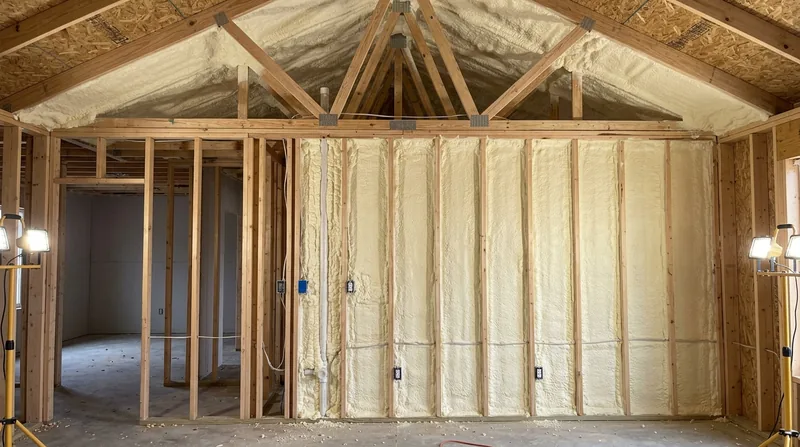




Commercial & New Construction Spray Foam in Sioux Falls lets builders and developers seal the building envelope before drywall goes up, capturing the efficiency gains that retrofit work can never match. Across Sioux Falls, Harrisburg, Tea, and Brandon, new construction pushes outward into prairie subdivisions where two-story homes with rooms over garages and unvented conditioned attics demand insulation designed in from the framing stage. The long heating season here, driven by IECC climate zone 6A winters that test every thermal boundary, makes the choice between open and closed cell foam a technical one anchored in moisture control and R-value per inch. A new build sprayed before drywall means no demolition, no weeks of cure time around occupied spaces, and no surprises when the heating bill arrives in January. We foam attics, walls, rim joists, and band joists on new commercial and residential construction across the region, working alongside builders and general contractors to meet code and deliver a tight envelope from day one.
Why New Construction Spray Foam Insulation Matters in Sioux Falls
New construction in Sioux Falls faces the same climate stress as every other building in zone 6A: cold, dry winters that pull moisture outward through the walls and attic, and warm, humid summers that drive it inward. Building the right thermal and air barrier from the start costs less than retrofitting a failed or settled insulation job five years later. Spray foam applied during framing captures every cavity, seals every penetration, and creates an unbroken thermal layer that blown-in or batted insulation cannot match. Closed cell foam delivers the highest R-value per inch and the moisture resistance that matters when condensation could otherwise form on the interior of a metal building or the rim joist of a new ranch. Open cell foam works well in interior walls where vapor permeability is an asset and R-value per dollar matters more than density. The building code in Sioux Falls and surrounding communities governs attic ventilation, ignition barriers, and thermal barriers, and the local building official has final say on what gets approved at your address.
- We apply closed cell foam to new construction attics and sealed roof decks to block moisture and deliver R-7 per inch.
- We spray open cell foam into wall cavities and rim joists where vapor permeability supports the drying potential of the assembly.
- We seal every rim joist, band joist, and penetration before the basement rim is left to run cold all winter.
- We work with builders and general contractors to schedule foam work between framing and drywall, minimizing cure time and job delays.
- We pull and verify R-value and thickness on every estimate so the builder and homeowner know exactly what they are getting.
Building tight from the start is the only way to avoid the stack effect and rim joist cold spots that plague older Sioux Falls homes and drive heating costs upward every winter.
Key info: New construction toward Harrisburg and Brandon often includes rooms over garages and two-story layouts where unvented attics pull cold air down through the rim joist. Foam applied during framing prevents that heat loss before drywall and insulation settle.
For guidance on what the building code requires at your address, contact your local building department or visit the South Dakota Department of Safety and Defense for state-level code resources.
How We Spray Foam New Construction in Sioux Falls: Process and Timing
New construction spray foam work is scheduled between framing inspection and drywall delivery, giving us a clear window to spray attics, walls, rim joists, and band joists without occupancy or cure-time complications. We arrive with equipment, material, and crew sized to the job scope. Closed cell foam cures in hours; open cell cures overnight. We establish mechanical ventilation during application and confirm the re-entry window with the builder and general contractor before leaving the site. The builder or GC schedules drywall crews after our cure window closes. On larger commercial builds, we coordinate with the mechanical and electrical trades to ensure foam does not block vents, ducts, or code-required clearances.
- We meet the builder at framing inspection to confirm foam scope, R-value targets, and application sequence.
- We spray attic decks, wall cavities, rim joists, and band joists in a single mobilization, minimizing schedule impact.
- We apply the correct material ratio, drum temperature, and pass thickness per the manufacturer specification for the product and climate.
- We run mechanical ventilation throughout application and the cure window to manage VOC and moisture.
- We document R-value, thickness, and coverage with photographs and a written summary for the builder and the final inspection.
Scheduling foam work during the framing-to-drywall window keeps the job on schedule and ensures the builder can close in the building on time.
Example: A new two-story home in Tea with an unvented attic and a garage below the master bedroom gets closed cell foam on the roof deck, open cell in the garage walls, and closed cell on the rim joist. We schedule the work for a Tuesday after framing inspection and before drywall delivery on Thursday. The job takes one day; cure is complete by Wednesday morning.
Learn more about how we handle air sealing and sealed attic design on our dedicated page.
Spray Foam Methods for New Construction: Closed Cell, Open Cell, and Hybrid Approaches
| Approach | Description | Best for |
|---|---|---|
| Closed Cell Spray Foam | High-density foam, R-7 per inch, moisture barrier, applied 1.5 to 2 inches per pass, cures in 4 to 8 hours. | Attic decks, sealed roof assemblies, rim joists, band joists, metal buildings, and any assembly where moisture resistance is critical. |
| Open Cell Spray Foam | Lower-density foam, R-3.5 per inch, vapor-permeable, applied 3 to 4 inches per pass, cures overnight. | Interior walls, garage walls, wall cavities where vapor drying is an asset, and cost-sensitive attics in conditioned spaces. |
| Hybrid (Closed Cell + Open Cell) | Closed cell on attic deck and rim joist for moisture control, open cell in interior walls to balance cost and drying potential. | New two-story homes, mixed-use buildings, and projects where budget and performance must both be optimized. |
| Wall Cavity Spray Foam (Closed Cell) | Closed cell applied into framed wall cavities before drywall, R-7 per inch, eliminates air leakage and settles zero. | New construction walls in zone 6A, rim joist cavities, and any assembly where air sealing and R-value must both be guaranteed. |
Commercial & New Construction Spray Foam Cost in Sioux Falls: What to Expect
The cost of commercial and new construction spray foam insulation in Sioux Falls depends on the scope of work, the type of foam, the square footage of attic or wall cavity, and the complexity of the building assembly. A free commercial estimate is the only honest starting point because spray foam is measured by the board foot on site, and the final square footage of attic or wall cavity is not known until we walk the building. Closed cell foam costs more per board foot than open cell, but delivers higher R-value per inch and complete moisture protection. Open cell costs less and works well in interior walls and conditioned attics. A new two-story home with an unvented attic, sealed roof deck, and full rim joist encapsulation typically runs higher than a single-story garage or a small commercial addition, but the cost per square foot of attic or wall cavity stays consistent across similar assemblies.
- Square footage of attic deck, wall cavity, or rim joist is the primary cost driver.
- Closed cell foam is priced higher than open cell because of its R-value density and moisture resistance.
- Access and equipment setup affect the timeline but not the per-board-foot material cost.
- Multiple passes and proper thickness per pass ensure the R-value shown in your estimate is delivered on the job.
- Travel is included in Sioux Falls and surrounding areas; no separate mileage fee applies.
The best way to understand what your new construction project will cost is to request a free commercial estimate with R-value and thickness specifications included. We respond within 24 hours and provide a written quote with no obligation to book.
What to Look for When Hiring a Spray Foam Contractor Near Sioux Falls
Hiring the right spray foam contractor for new construction is a decision that affects the building's thermal performance, air quality during cure, and the warranty coverage that backs the work. A reputable local contractor in Sioux Falls will ask detailed questions about the building assembly, the code requirements at your address, and the moisture profile of the climate zone. They will provide a written estimate with R-value and thickness specifications, not just a price per square foot. They will explain the difference between open cell and closed cell, and why one might be better than the other for your specific assembly. They will confirm that they are fully insured and will pull any permits required by your local building department. They will not promise immediate re-entry or skip mechanical ventilation during cure. They will not claim the foam is non-toxic or 100% safe in absolute terms, but will explain that correct installation, controlled thickness, proper ratio, and a stated re-entry window of 24 to 48 hours are the standard of care.
- Ask for a written estimate with R-value per inch and thickness per pass, not just a dollar amount.
- Verify that the contractor is fully insured and ask for a certificate of insurance naming your project.
- Get at least two estimates from contractors in Sioux Falls or nearby communities so you can compare scope and price.
- Ask about the builder's or GC's experience with the contractor and whether the job stayed on schedule.
- Confirm that the contractor will run mechanical ventilation during application and state the re-entry window in writing.
- Check with your local building department to understand what permits apply at your address and whether the contractor helps navigate the approval process.
The local independent contractor with a Sioux Falls address and a track record with builders in the area is your best resource. Call us at (605) 937-7766 or contact us online to discuss your new construction project and schedule a free estimate.
Commercial & New Construction Spray Foam in Sioux Falls: Pricing Guide
| Service | Price | Details |
|---|---|---|
| Free Commercial Estimate | Free | Written scope with R-value, thickness, and board-foot total. Response within 24 hours at (605) 937-7766. |
| Closed Cell Spray Foam | Starting at $1.50 to $2.25 per board foot | Varies by application depth, attic square footage, and material supplier cost. Higher R-value and moisture protection justify premium. |
| Open Cell Spray Foam | Starting at $0.65 to $1.10 per board foot | Lower cost than closed cell, suitable for interior walls and conditioned attics where vapor permeability is acceptable. |
| New Construction Attic or Rim Joist Job | On estimate | Scope, square footage, foam type, and accessibility determine final price. Typically quoted per board foot with labor included. |
| Travel | Included | No separate mileage or call-out fee in Sioux Falls and surrounding service areas. |
Indicative pricing, the exact cost depends on square footage, finish, and site access. Free personalized estimate within 24h at (605) 937-7766.


