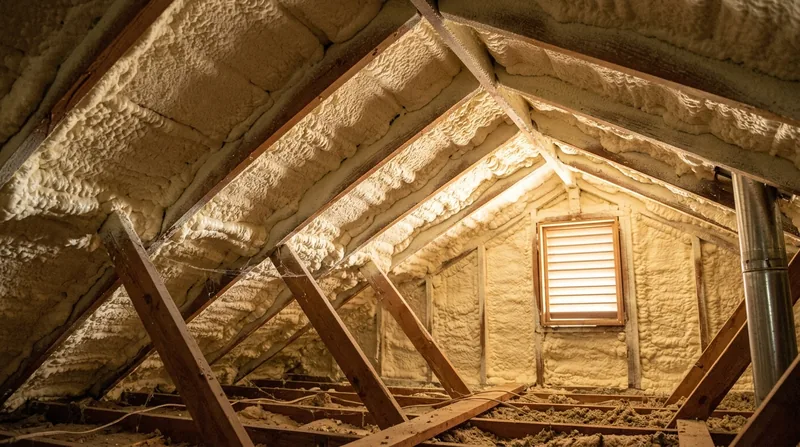




Attic spray foam insulation in Sioux Falls stops the heat loss that drives energy bills through long prairie winters and protects against the moisture buildup that follows stack effect in tight homes. Sioux Falls sits in climate zone 6A, where heated air rises through attics and escapes while cold infiltrates at rim joists and basements, and where the dew point inside wall cavities becomes a real concern from November through March. Whether your home is a downtown Victorian with original cavities, a postwar ranch with settled fiberglass, or a new two-story in Harrisburg or Tea, an unvented attic deck sealed with spray foam stops that upward pull and puts the attic outside the conditioned envelope. We spray foam attic decks, rafter cavities, and the air sealing around them to stop heat loss and moisture problems in homes from downtown to the edges of Minnehaha and Lincoln counties. The work is permanent, requires no maintenance, and addresses the single biggest thermal leak in most Sioux Falls homes.
Why Attic Spray Foam Insulation Matters in Sioux Falls: Heat Loss and Stack Effect
Sioux Falls winters are long and severe, with outdoor temperatures dropping well below zero for weeks at a time. Your attic is not insulated from the outdoors; it is exposed to full winter cold, and any gap in coverage or any air leak at the rim joist pulls warm air upward and out. This upward flow, called stack effect, is not a small problem. It is the dominant failure mode in Sioux Falls homes, and it cannot be fixed by adding more blown-in fiberglass to an attic that is already vented and leaky. Spray foam seals the attic deck and the rafters in a single pass, stopping air movement and holding R-value in place for decades.
- Stack effect pulls heated air upward through any gap in the attic floor, ceiling, or rim joist connection.
- Fiberglass settles and compresses over time, losing R-value and leaving voids where air leaks through.
- Spray foam adheres to rafters, joists, and rim bands, sealing air leaks while providing continuous insulation.
- An unvented attic deck keeps the attic outside the conditioned envelope, reducing the volume you have to heat.
- Moisture from indoor air that reaches a cold attic surface will condense and rot framing; foam eliminates that surface and the air that reaches it.
A properly sealed attic with spray foam insulation stops the stack effect that is costing you money every heating season in Sioux Falls.
Key info: Homes in downtown Sioux Falls, Brandon, and Harrisburg that were built before 1970 often have full basements with uninsulated rim joists running the perimeter. That rim joist is where cold enters in winter. Spray foam on the attic deck stops the pull, but a complete solution also seals the rim and band joist below. Many homeowners tackle one or the other first. Both matter.
For more on how closed cell spray foam handles the moisture side of the equation in cold climates, see our closed cell spray foam insulation page.
How We Spray Foam an Attic Deck in Sioux Falls: The Process
Attic spray foam work begins with a site visit and a written estimate that specifies the R-value you are getting, the foam thickness in each area, and the total board feet we will apply. We assess attic access, existing insulation condition, and any air leaks that need sealing before foam goes down. If old insulation is present and in poor condition, we remove it first. We then seal rim and band joists, band board gaps, and any penetrations where utilities enter the attic. Once the substrate is clean and dry, we spray the attic deck and rafter cavities with either closed cell or open cell foam, depending on your climate needs and budget. Closed cell foam is denser, carries higher R-value per inch, and is the choice for Sioux Falls winters. Open cell is lighter, costs less, and works well for sound dampening in rooms below attics. We control thickness on every pass, maintain manufacturer drum temperature, and run mechanical ventilation during cure. Re-entry is safe after twenty-four to forty-eight hours.
- We visit the attic, measure the deck, and assess existing insulation and air leaks.
- We provide a written estimate with R-value and thickness specs before any work begins.
- We remove old or failed insulation if it is present and blocking the substrate.
- We seal air leaks at rim joists, band boards, and utility penetrations with foam.
- We spray the attic deck and rafter cavities to the thickness and R-value specified in the estimate.
- We maintain mechanical ventilation during cure and provide a re-entry window of twenty-four to forty-eight hours.
The entire process from estimate to cure completion typically takes one to two weeks, depending on attic size and existing conditions.
Local example: A 1,500 square foot ranch in Tea with a vented attic, settled fiberglass, and a cold basement gets a full attic deck spray with closed cell foam to R-49, plus rim joist sealing. The job takes three to four days from start to cure, costs between $3,500 and $5,200 depending on attic access and existing debris, and drops heating bills by 20 to 30 percent in the first winter. The homeowner can safely re-enter after two days.
For more on insulation that may need to be removed first, see our insulation removal page.
Attic Spray Foam Insulation Methods: Closed Cell vs. Open Cell
| Approach | Description | Best for |
|---|---|---|
| Closed Cell Spray Foam | Dense, rigid foam with small cells that resist moisture and air. R-value 6 to 7 per inch. Provides air barrier and moisture barrier in a single application. Low permeability. | Sioux Falls attics in climate zone 6A where winter cold and summer humidity are both severe. Unvented attic decks. Rim joists and band joists. Condensation control is the priority. |
| Open Cell Spray Foam | Lighter, semi-rigid foam with larger cells. R-value 3 to 4 per inch. Provides excellent air barrier but is vapor permeable. Lower cost per board foot. Good sound dampening. | Budget-conscious attic top-ups in homes where existing insulation is sound and vented attics are acceptable. Sound control in rooms below attics. Mild climates (not Sioux Falls primary choice). |
| Rim Joist and Band Joist Spray Foam | Closed cell foam applied to the rim board, band joist, and rim cavity where the house frame meets the foundation. Typically 4 to 6 inches. Seals the coldest air leak in most Sioux Falls homes. | Every Sioux Falls home with a basement or crawl space. This is the entry point for stack effect and the second-largest thermal leak after the attic in homes built before 1990. |
| Combination: Attic Deck + Rim Joist Sealing | Full envelope sealing that addresses both the upward pull (attic) and the entry point (rim joist). Closed cell in both locations. Eliminates the two largest air leaks in the typical Sioux Falls home. | Homes where energy bills are high, basements are cold, and upstairs rooms are hard to heat. Maximum efficiency gain and comfort improvement. Most cost-effective long-term investment. |
Attic Spray Foam Insulation Cost in Sioux Falls: What to Expect
Attic spray foam insulation in Sioux Falls typically costs between $1.50 and $3.50 per square foot of attic deck, depending on the foam type, the R-value you choose, attic access, and the condition of existing insulation. Closed cell foam, which is the standard for Sioux Falls winters, runs toward the higher end because it carries greater R-value per inch and provides superior moisture control. Open cell is less expensive per square foot but requires more thickness to reach the same R-value. A typical 1,500 square foot attic deck sprayed to R-49 with closed cell foam costs between $3,000 and $5,500. If you also seal rim and band joists, add $800 to $1,500 depending on the perimeter and cavity depth. Removal of old insulation is a separate line item, typically $0.50 to $1.00 per square foot of attic deck.
The factors that move the price are straightforward. A tight attic with good access and clean substrate is faster and cheaper. An attic with settled fiberglass, debris, or difficult access costs more because removal and cleanup take time. Attic size matters; a large attic spreads equipment setup and crew time over more square footage. The R-value you choose is the biggest variable. R-38 costs less than R-49, which costs less than R-60. Most Sioux Falls homes built before 2000 benefit most from R-49 to R-60 in the attic deck; newer construction may be R-38 if the attic is already partially insulated and you are topping up.
We always provide a written estimate with the R-value, thickness, and total board feet specified before work begins. The estimate is free and includes the cost of removal if needed. Getting two or three estimates from different contractors is smart; it forces clarity on what you are paying for and protects you against lowball quotes that cut corners on thickness, ventilation during cure, or substrate preparation. See our full pricing overview for more detail on what moves the cost, and call us at (605) 937-7766 for a free estimate.
Attic Spray Foam Insulation Near Me: What Sioux Falls Homeowners Should Know Before Hiring
Spray foam insulation is a permanent, high-value investment, and the quality of the installation determines whether you get the R-value, the air sealing, and the durability you paid for. Before you hire any contractor, verify their insurance and ask to see the certificate. Ask for references from recent attic jobs in Sioux Falls, Tea, Harrisburg, or Brandon, and call at least two. Insist on a written estimate that specifies the R-value and the foam thickness in inches; if the estimate does not include those numbers, walk away. Ask how the contractor will handle mechanical ventilation during cure and what re-entry window they guarantee. Ask whether they remove old insulation before spraying; if they plan to spray over settled or contaminated fiberglass, that is a red flag. Permits and building code compliance vary by city across Greater Sioux Falls. Downtown Sioux Falls, Brandon, Tea, and Harrisburg each have their own building department and their own rules about attic ventilation, thermal barriers, and ignition barriers. Your contractor should be familiar with what applies at your address, but the final responsibility for permit requirements rests with you and the local building official. Call your city building department if you are unsure whether a permit is required; a few minutes of clarity upfront saves problems later.
- Verify the contractor is fully insured and ask to see the certificate of insurance.
- Request written references from attic jobs completed in the last two years in Sioux Falls or nearby cities.
- Insist on a written estimate that states the R-value, foam thickness in inches, and total square footage.
- Ask how the contractor ensures proper substrate preparation and mechanical ventilation during cure.
- Confirm that old insulation will be removed if it is settled, contaminated, or blocking the substrate.
- Check with your local building department to confirm whether a permit is required for attic spray foam work at your address.
The best contractors in this trade are local, responsive, and clear about what they are doing and why. Call us at (605) 937-7766 or visit our contact page to request a free estimate with no obligation.
Attic Spray Foam Insulation in Sioux Falls: Pricing Guide
| Service | Price | Details |
|---|---|---|
| Attic Deck Spray Foam (Closed Cell) | Starting at $1.50/sq ft | R-38 to R-49 coverage, includes substrate prep, air sealing, and mechanical ventilation during cure; larger attics and good access reduce per-foot cost |
| Attic Deck Spray Foam (Open Cell) | Starting at $1.00/sq ft | R-30 to R-40 coverage, lower cost alternative for top-ups or sound dampening; requires more thickness than closed cell to reach same R-value |
| Rim Joist and Band Joist Sealing | Starting at $8.00/linear ft | Closed cell foam applied 4 to 6 inches deep around the rim and band joist perimeter; cost varies by cavity depth and accessibility from basement or crawl space |
| Old Insulation Removal | Starting at $0.50/sq ft | Removal and disposal of settled fiberglass, blown-in cellulose, or failed foam before new insulation is installed; larger jobs and hazardous materials add cost |
| Complete Attic + Rim Joist Package | On estimate | Full envelope sealing combining attic deck and rim joist work; scope and site conditions determine final price, typically $4,500 to $8,000 for a 1,500 sq ft home |
| Free Estimate | No charge | Written estimate with R-value and thickness specs provided within 24 hours; call (605) 937-7766 or request online with no obligation to book |
Indicative pricing, the exact cost depends on square footage, finish, and site access. Free personalized estimate within 24h at (605) 937-7766.


