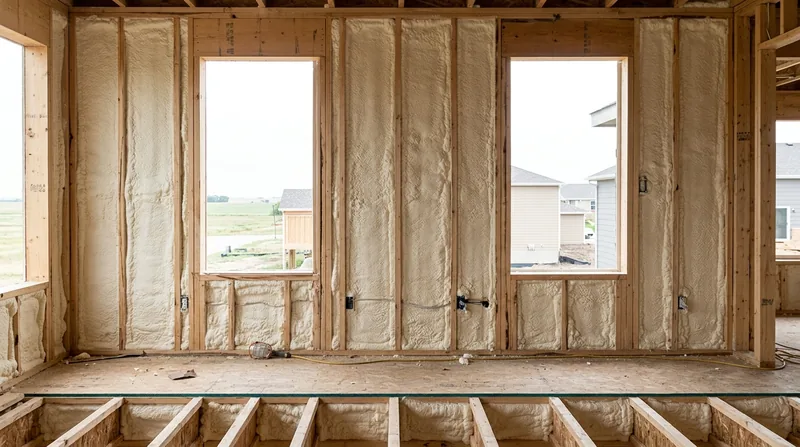




Open cell spray foam insulation in Sioux Falls seals the air leaks that drive your heating bills through the winter and lets cool air escape in summer. Sioux Falls sits in IECC climate zone 6A, where long, hard prairie winters put the building envelope to the test. The stack effect pulls heated air up and out through attic seams and bypasses while cold air infiltrates at rim joists and basement band joists below. Early-1900s homes along the Big Sioux River carry original wall cavities and attics never built for today's heating demands. Postwar ranches across the city have vented attics with settled insulation and uninsulated rim joists. New subdivisions toward Tea and Brandon bring two-story construction and rooms over garages where unvented, conditioned attics can be built right from the start. Open cell foam addresses these air leaks directly, sealing interior walls and attic rafters against the infiltration that matters most in this climate. Call us at (605) 937-7766 for a free estimate, or visit our pricing page to see what open cell spray foam costs in your area.
Why Open Cell Spray Foam Matters in Sioux Falls Homes
Sioux Falls winters are long and severe, and the heating season runs from October through April. The dew point inside walls and attics becomes a real concern through the coldest months, especially in older homes where original cavities were never sealed. Open cell foam fills stud bays and attic decks with a semi-rigid foam that expands to conform to irregular framing and blocks both air movement and moisture diffusion. It works well in attics where condensation risk is lower and in interior walls where the thermal gradient is less extreme than in closed cell applications. The softer cellular structure also provides sound dampening, a bonus in rooms over garages or between bedrooms on new subdivisions in Brandon and Tea.
- Open cell foam seals air leaks that closed fiberglass batts cannot reach, stopping the stack effect that pulls warm air upward through attic seams.
- It conforms to irregular framing, bypasses, and notches without compression, filling voids that cause cold spots and drafts.
- The material cures to a semi-rigid state, holding its shape and R-value over decades without settling or compacting.
- It absorbs sound and reduces noise transmission between rooms, a real benefit in new two-story homes and rooms over garages.
- Open cell foam costs less per board foot than closed cell, making it the practical choice for attic and interior wall applications where vapor barriers are not required by code.
Choosing open cell over closed cell comes down to use case, not brand loyalty. We recommend the right foam for your home's actual risk profile and budget.
Key info: Sioux Falls building code and your local building official govern whether your attic needs a thermal barrier and how much ventilation applies. Open cell foam requires a fifteen-minute thermal barrier if applied to the underside of roof decks. We help you navigate what applies at your address and defer to the building department for the final call.
For more on the technical differences between foam types and when each makes sense, see our closed cell spray foam page, which covers the high-density option for crawl spaces, metal buildings, and other condensation-critical applications.
How We Spray Open Cell Foam in Sioux Falls Attics and Walls
Open cell spray foam installation is a controlled process that starts with site inspection and ends with a re-entry window of twenty-four to forty-eight hours. We measure the cavity depth, confirm the substrate is dry, and verify that mechanical ventilation can run during and after the spray. The foam is mixed at the correct ratio and drum temperature, then sprayed in multiple thin passes to build up the specified thickness without over-packing. Excess foam is trimmed flush to the framing, and we confirm the final R-value and thickness match the estimate before we leave the site.
- We inspect the attic or wall cavity for moisture, leaks, or contamination and walk away if the substrate is not dry enough for foam.
- We set up mechanical ventilation during the spray and cure window to manage VOC off-gassing and ensure safe re-entry timing.
- We spray open cell foam in thin passes, allowing each layer to set before adding the next, building to the R-value and thickness specified in your estimate.
- We trim excess foam flush to the framing and provide a written record of the final thickness, board footage, and R-value achieved.
- We explain the re-entry window (typically twenty-four to forty-eight hours) and any follow-up work, such as drywall installation or exterior trim.
This process takes longer than a rig-and-run crew would spend, and it costs more than a basement-level estimate, because it is built to work.
Example: A 1,200-square-foot attic in a 1960s ranch in Sioux Falls typically receives 5.5 inches of open cell foam to reach R-19, using roughly 6,600 board feet. The job takes one day to spray, one day to cure, and the homeowner re-enters after forty-eight hours. Total cost falls in the range we discuss below. Contrast this with a postwar attic in Tea where existing fiberglass is matted down: we remove the old insulation first, then spray new open cell foam to the same R-value.
For jobs requiring removal of failed or contaminated insulation before we spray, see our insulation removal page.
| Approach | Description | Best for |
|---|---|---|
| Open Cell Attic Foam (New Spray) | Spray open cell foam directly onto attic framing or deck to R-19 or R-21, no removal required if existing insulation is sound and dry. | Vented attics with compressed fiberglass, uninsulated or under-insulated attics in newer homes, and attics where existing R-value needs a top-up. |
| Open Cell Attic Foam (After Removal) | Remove settled, wet, or contaminated insulation, air seal the cavity, then spray open cell foam to spec. | Postwar ranches with failed fiberglass, attics with moisture history, and homes where a clean slate is required before new insulation. |
| Open Cell Wall Cavity Foam | Inject or spray open cell foam into wall cavities from the interior (via small holes) or exterior (during renovation or new construction). | Pre-1980 homes in Sioux Falls with uninsulated or partially insulated wall cavities, and new construction where walls are open before drywall. |
| Open Cell Rim Joist and Band Joist Foam | Seal the rim or band joist (the perimeter framing above the foundation) with open cell foam to stop cold air infiltration and convective heat loss. | Full basement homes across Sioux Falls, Harrisburg, and Tea where cold rim joists drive basement temperatures down and heating bills up. |
| Open Cell Garage Ceiling Foam | Spray open cell foam on the underside of roof decks or floor joists above attached garages to stop cold air and garage odor from entering the home. | New subdivisions in Brandon and Tea with rooms over garages, and older homes in Sioux Falls where garage ceilings are uninsulated or drafty. |
Open Cell Spray Foam Insulation Cost in Sioux Falls: What to Expect
Open cell spray foam typically costs starting at $0.55 per board foot in Sioux Falls, with most residential attic and wall jobs landing in the $1,200 to $3,500 range depending on square footage, existing insulation, and access. A 1,200-square-foot attic sprayed to R-19 (roughly 6,600 board feet) runs in the mid-range of that estimate. Removal of old insulation, air sealing around penetrations, and travel time within Sioux Falls and surrounding areas are factored into the quote. Jobs in Brandon, Tea, Harrisburg, and other service areas carry no separate mileage charge.
Several factors move the cost up or down. A clean, dry attic ready to spray costs less than one requiring removal of settled or wet fiberglass. Wall cavity foam in older Sioux Falls homes may require drilling small holes and injecting foam, which adds labor. New construction in subdivisions toward Tea or Brandon often allows us to spray walls before drywall, which is faster and cleaner than retrofit work. Access also matters: a wide attic hatch and clear joists make the job faster than a cramped space with obstructions.
We provide a written estimate with the R-value, thickness, and board footage specified for your home. The estimate is free and carries no obligation. If you want to compare pricing, get two or three estimates from other contractors in Sioux Falls and verify they include the same R-value and thickness. A price far below market, an estimate with no R-value or thickness stated, or a contractor who promises immediate re-entry without mechanical ventilation are red flags. Call us at (605) 937-7766 or visit our contact page to schedule your free estimate.
What to Look for When Hiring a Spray Foam Contractor Near Sioux Falls
Choosing the right spray foam contractor matters as much as choosing the right insulation type. Sioux Falls has local independent shops, national franchises, and out-of-state rig-and-run crews, each with a different approach to quality and accountability. The local independent contractor is positioned to offer honest guidance and local follow-up if something does not perform as expected. Before you hire, verify that the contractor is fully insured, ask for references from recent jobs in Sioux Falls or nearby areas, and request a written estimate that includes R-value, thickness, and board footage. Do not rely on a phone quote alone; a reputable contractor will visit your home and measure the space.
Permitting and registration rules vary by city within Greater Sioux Falls. Sioux Falls proper, Brandon, Tea, Harrisburg, and smaller towns like Dell Rapids and Hartford each have their own building department and may require a permit for spray foam work. We help you navigate what applies at your address and defer to the local building official for the final call. Ask any contractor whether they pull permits or whether the homeowner is responsible. Honest contractors will explain the permit process upfront and never promise to skip it.
Check references carefully. Ask for contact information for three to five recent jobs in your area and follow up with those homeowners. A good contractor will provide references without hesitation. Ask about re-entry timing, any odor or off-gassing issues, and whether the work was completed on schedule. If you are in an HOA-governed subdivision toward Brandon or Tea, confirm that the contractor understands any architectural restrictions on exterior work. Most HOAs do not govern insulation, but a few do, and it pays to ask.
Finally, trust your instinct about communication and transparency. A contractor who answers your questions clearly, explains the process in plain language, and is reachable by phone is more likely to stand behind the work. Call us at (605) 937-7766 or contact us online to discuss your project and get a free estimate from a local Sioux Falls spray foam contractor.
Open Cell Spray Foam Insulation in Sioux Falls: Pricing Guide
| Service | Price | Details |
|---|---|---|
| Open Cell Attic Foam (New Spray) | Starting at $0.55/board ft | Typical 1,200 sq ft attic to R-19 runs $1,200 to $2,200. Cost rises with attic size, access difficulty, and removal of existing insulation |
| Open Cell Attic Foam (After Removal) | Starting at $0.55/board ft | Removal of old insulation adds $400 to $800 depending on volume and contamination. Final foam cost calculated separately after cavity is clean and dry |
| Open Cell Wall Cavity Foam | Starting at $0.60/board ft | Retrofit injection into closed walls costs slightly more than attic work due to drilling and access. Typical pre-1980 home wall cavity retrofit runs $1,500 to $3,000 |
| Rim Joist and Band Joist Foam | Starting at $0.55/board ft | Typical full basement perimeter runs 500 to 1,200 linear feet. Cost depends on joist depth and basement access. Typical job $800 to $1,800 |
| Travel and Estimate | Included / Free | No mileage fee in Sioux Falls and surrounding service areas. Free written estimate with R-value and thickness specs, no obligation to book |
Indicative pricing, the exact cost depends on square footage, finish, and site access. Free personalized estimate within 24h at (605) 937-7766.


