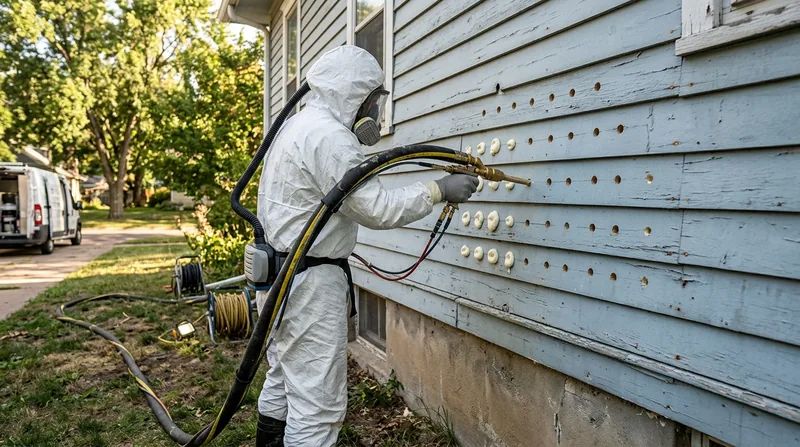




Wall & Injection Foam Insulation in Sioux Falls fills closed wall cavities in early-1900s homes without opening plaster or drywall, a critical retrofit for original construction near the Big Sioux River that was never designed for today's heating demands. Sioux Falls sits in IECC climate zone 6A, where long, hard prairie winters drive heat loss through uninsulated exterior walls at a steady rate, and the stack effect pulls warm air upward through rim and band joists while cold infiltrates from below. Injection foam addresses the core problem: original wall cavities that are either empty, partially settled, or filled with materials that have lost their thermal resistance over a century of hard winters. Unlike spray foam applied to open cavities, injection foam works behind intact surfaces, preserving the historic character of homes in the downtown core and along the river while sealing the thermal leaks that drive winter heating bills. We help homeowners and property managers understand whether injection foam is the right choice for their wall, what the process looks like, and what to expect from a properly installed system.
Why Wall & Injection Foam Insulation Matters for Sioux Falls' Early-1900s Homes
Sioux Falls' original residential stock, concentrated near downtown and along the Big Sioux River, was built with solid masonry, brick, and wood-frame construction. The wall cavities in these homes were either never insulated or filled with materials like sawdust, newspaper, or loose mineral wool that have compressed and lost effectiveness over decades. The result is a thermal envelope that performs poorly in a 6A climate where winter temperatures drop to minus 20 degrees Fahrenheit and stay there for weeks. Injection foam fills these cavities completely, conforming to irregular spaces and settling issues without requiring interior or exterior demolition. This matters because heating costs in these older homes run high, and the alternative, opening walls for spray foam, is expensive and disruptive to historic finishes and plaster work.
- We drill small holes through the exterior or interior surface, spaced vertically along the wall cavity.
- Injection foam is pumped under controlled pressure to fill the cavity from bottom to top, ensuring complete saturation and no voids.
- Holes are plugged and patched, leaving minimal visible trace on finished surfaces.
- The cured foam adds structural rigidity to the wall and improves air sealing around the perimeter.
- Injection foam works in walls where spray foam cannot be safely applied because the cavity is already enclosed.
Injection foam is the practical answer for homes where the walls are finished and the homeowner wants to improve insulation without renovation.
Key info: A 1910 brick home in downtown Sioux Falls with uninsulated 2x4 walls loses heat continuously through exterior walls in winter. Injection foam can raise the effective R-value of that wall cavity from near zero to R-13 or higher, depending on foam type and cavity depth. This translates to measurable warmth at the exterior wall and reduced heating run time.
For more information on how insulation retrofits integrate with the rest of your home's envelope, see our guide to air sealing in Sioux Falls.
How Injection Foam Insulation Works in Sioux Falls Homes
Injection foam insulation is a methodical process that requires careful site assessment, proper equipment, and controlled application. The cavity must be evaluated for moisture, structural integrity, and accessibility before foam is introduced. We assess wall depth, cavity type, and any existing insulation or debris that might interfere with proper fill. The injection process itself is straightforward but demands precision: holes are drilled at intervals, foam is pumped into the cavity under low pressure to avoid rupturing the wall, and the foam expands slightly to fill all voids. The entire wall must be filled uniformly, from bottom to top, to avoid settling or voids that reduce performance. Once cured, the foam is solid, non-settling, and provides continuous thermal resistance for the life of the building.
- We inspect the wall cavity using borescope or thermal imaging to identify obstructions, moisture, or structural issues.
- Drill holes are marked at 12 to 16 inch intervals vertically along the wall, typically on the exterior or least-visible interior surface.
- Injection hose is inserted into the lowest hole, and foam is pumped at controlled pressure until it reaches the top hole and begins to overflow.
- Each hole is sealed in sequence as the foam rises, ensuring the cavity fills completely and uniformly.
- Holes are patched with foam-compatible caulk or filler and sanded flush, then painted or stained to match the surrounding surface.
- The wall is left undisturbed for 24 to 48 hours to allow full cure before any interior finishes are reinstalled or moved.
The result is a fully insulated wall cavity with no voids, improved air sealing, and no disruption to the home's interior or exterior finishes.
Example: A 1920s brick colonial in Tea with original 2x4 exterior walls and plaster interior wanted better winter comfort without opening walls or refinishing rooms. Injection foam filled the cavities from the exterior, holes were patched flush with the brick mortar, and the homeowner saw a 12 to 18 degree Fahrenheit improvement in exterior wall surface temperature during the following winter. The work took one day and required no interior access or disturbance.
To understand how injection foam fits into a broader insulation strategy, review our closed cell spray foam and insulation removal services, which often precede or complement wall injection work.
Injection Foam Methods and When to Use Each
| Approach | Description | Best for |
|---|---|---|
| Open Cell Injection Foam | Lower density, expands more, slightly lower R-value per inch, allows some vapor transmission, lower cost per board foot. | Interior walls, sound dampening, retrofit in dry climates or walls with vapor barriers already in place. |
| Closed Cell Injection Foam | Higher density, minimal expansion, R-6.5 to R-7 per inch, vapor barrier properties, moisture resistant, higher cost per board foot. | Exterior walls in zone 6A, walls below grade, walls exposed to weather, cavities at risk of moisture infiltration. |
| Retrofit into Settled Insulation | Injection foam pumped around existing loose or compressed insulation to fill voids and improve contact with cavity walls. | Walls with original loose-fill that has settled, mineral wool that has compacted, or partial insulation that needs density improvement. |
| Empty Cavity Fill | Complete fill of uninsulated cavities in homes where original construction included no insulation or insulation was removed. | Downtown Sioux Falls brick homes, riverfront colonials, early 1900s construction with no insulation history. |
Wall & Injection Foam Insulation Cost in Sioux Falls: What to Expect
Wall injection foam pricing in Sioux Falls typically starts at $2 to $3 per square foot of wall cavity filled, depending on cavity depth, foam type, accessibility, and whether existing insulation or debris must be managed. A 2x4 exterior wall cavity holds roughly 3 board feet per linear foot, so a 100 linear foot wall might cost $600 to $900 in material and labor alone. Closed cell foam runs higher than open cell because of material cost and the technical precision required for proper application in exterior walls where moisture control matters. Accessibility affects price significantly: a ground-floor wall with clear exterior access costs less than a second-story wall requiring scaffolding or lift equipment. If the wall contains asbestos-bearing materials, vermiculite, or other hazardous insulation, that material must be assessed and potentially removed by a licensed professional before injection can proceed, which adds cost and timeline. The best way to understand your specific cost is to request a free written estimate that includes the foam type, R-value, thickness per cavity, and total board feet to be filled.
See our full pricing page for detailed breakdowns of injection foam costs and related services.
Wall & Injection Foam Insulation Near Me: What to Look for When Hiring a Contractor in Sioux Falls
Hiring the right spray foam insulation contractor is the single biggest factor in whether your wall injection project performs as intended and stays problem-free for decades. Start by verifying that the contractor is fully insured and can provide a current certificate of insurance before work begins. Ask for written estimates from at least two contractors that include the foam type, R-value, thickness per cavity, total square footage, and board feet to be filled. Avoid any estimate that omits these details or quotes a price without inspecting the wall. Check references from recent projects in Sioux Falls or nearby areas, and ask specifically about cure time, odor management, and whether the homeowner noticed any settling or performance issues in the months after completion. Understand what permits apply at your address by contacting the city or county building department, particularly if your home is in a historic district or subject to HOA architectural review. A contractor who helps you navigate local permitting requirements and defers to the building official is demonstrating the local knowledge that matters.
- Request at least two written estimates that specify foam type, R-value, thickness, and total board feet before any commitment.
- Verify the contractor's insurance coverage and ask to see the certificate of insurance naming your address as an additional insured.
- Ask about the contractor's experience with walls similar to yours, including age, construction type, and any prior insulation history.
- Confirm that mechanical ventilation will be used during cure and that a re-entry window of 24 to 48 hours will be observed.
- Check with the Sioux Falls building department or your city's permit office to understand what approvals or notifications are required for your wall type and location.
- Ask whether the contractor has worked in your neighborhood or on similar homes and request contact information for recent local references.
Taking time to vet your contractor upfront protects your investment and ensures the work is done correctly the first time.
Ready to move forward? Contact us for a free estimate and we'll walk you through the process, answer your questions, and provide a detailed scope of work before any commitment.
Wall & Injection Foam Insulation in Sioux Falls: Pricing Guide
| Service | Price | Details |
|---|---|---|
| Open Cell Injection Foam | Starting at $2/sq ft | Interior walls and retrofit applications where moisture control is secondary to cost savings and sound dampening |
| Closed Cell Injection Foam | Starting at $2.75/sq ft | Exterior walls in zone 6A, below-grade cavities, and moisture-exposed areas where vapor barrier properties are critical |
| Wall with Existing Settled Insulation | On estimate | Requires inspection to assess cavity condition, existing material type, and whether hazardous materials testing or professional removal is needed first |
| Historic or Masonry Wall Retrofit | On estimate | Brick or stone construction in downtown Sioux Falls or river homes requires careful access planning and specialized drilling techniques |
| Travel and Site Visit | Included | No separate charge for estimates or travel within Sioux Falls and surrounding service areas |
| Free Written Estimate | Free | Detailed scope including foam type, R-value, thickness, and total board feet, with response within 24 hours at (605) 937-7766 |
Indicative pricing, the exact cost depends on square footage, finish, and site access. Free personalized estimate within 24h at (605) 937-7766.


