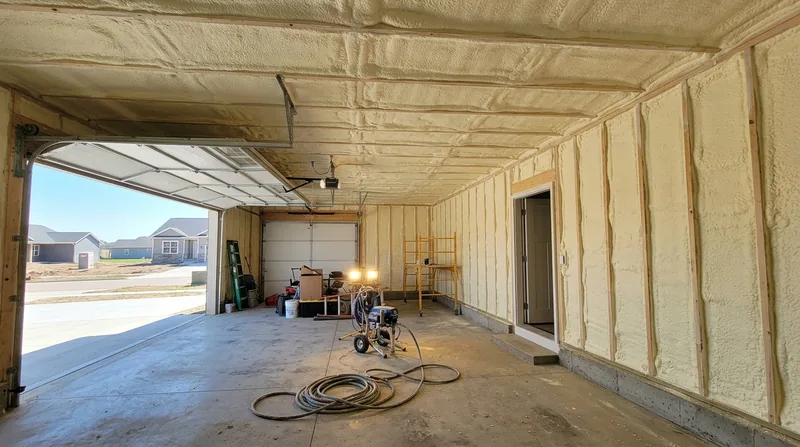




Garage spray foam insulation in Sioux Falls addresses the seasonal reality of attached garages that face blizzard winds, temperature swings between frozen winters and hot summers, and the stack effect that pulls conditioned air up through the ceiling into uninsulated rim joists and attics. Attached garages in Minnehaha County take direct hits from winter storms and summer heat that uninsulated walls and ceilings cannot resist. Rooms built above garages stay cold in winter and hot in summer when the garage itself is open to the elements. We foam garage walls and ceilings so the space holds steady through the seasonal extremes, and rooms above the garage stop losing heat or cooling to an uncontrolled buffer zone. This is not a luxury upgrade in a 6A climate. It is a structural decision that pays for itself in comfort and utility bills over ten to fifteen years.
Why Garage Spray Foam Insulation Matters in Sioux Falls and Greater Minnehaha County
Attached garages in Sioux Falls, Brandon, Tea, and Harrisburg are thermal liabilities by design. The garage door opens to outside air, the walls and ceiling face the weather directly, and most garages built before 2000 have zero insulation in the walls and only fiberglass batts (or nothing) in the ceiling. In winter, the garage becomes a cold box that bleeds heat into the house through the shared wall and ceiling. In summer, solar gain on the roof and walls turns the garage into an oven that forces the air conditioning to work harder. Rooms directly above the garage experience temperature swings of 20 to 30 degrees across a single day in March or September.
- Spray foam seals the garage walls and ceiling so outside air and temperature extremes do not penetrate into the conditioned space above.
- Closed cell foam on the ceiling resists the moisture that winter humidity and summer condensation bring into unvented garage spaces.
- A foamed garage ceiling stops the stack effect from pulling heated air out of the house and into the attic in winter.
- Rooms above the garage stay within 5 to 10 degrees of the rest of the house year-round, not 20 to 30 degrees swings.
- Utility bills drop because the heating and cooling system does not have to compensate for an uninsulated thermal bridge.
These are not theoretical gains. They are the direct result of eliminating air leakage and thermal bridging in a space that was never insulated in the first place.
Key info: A Sioux Falls homeowner with a two-story ranch built in 1995 reported that the bedroom above the garage dropped to 58 degrees in January while the rest of the house held at 72. After garage ceiling foam, that room stayed at 70 degrees with no additional heating. The utility bill for that winter dropped by 12 percent.
South Dakota's building code requires that garages be separated from conditioned space by air barriers and insulation. Most older garages do not meet this standard. When you foam the walls and ceiling, you bring the garage into compliance and you stop the energy leak that drives heating and cooling bills. For more on how insulation works in different climates, see our page on closed cell spray foam insulation.
How We Insulate Garages in Sioux Falls: Process and Approach
Garage spray foam insulation starts with an inspection of the existing structure, the condition of the roof deck and walls, and whether the garage is vented or unvented. We assess the moisture profile, check for any active leaks or water intrusion, and confirm that the substrate is dry and clean before we spray. If the garage has a vented soffit or ridge vent, we seal those openings so the foam creates a continuous air barrier. We then spray closed cell foam on the ceiling and walls to a thickness that meets your local building code and your energy goals. The process takes one to two days for a typical two-car garage, including cure time before the space can be re-entered.
- We inspect the garage structure, roof deck, and walls for moisture, leaks, and substrate condition before any foam is sprayed.
- We seal vents and openings in the soffit and roof so the foam creates a complete air barrier without gaps.
- We spray closed cell foam at the correct thickness and density per the manufacturer ratio and your local building code.
- We maintain mechanical ventilation during cure and provide a re-entry window of 24 to 48 hours before the space is safe for normal use.
- We install a thermal barrier (drywall or intumescent paint) if the code at your address requires one.
The entire process is done on site with equipment that we control. You get a written estimate with R-value and thickness specs before we start, and you know what the finished installation will look like and perform.
Real example: A homeowner in Harrisburg with a three-car garage and a finished office above it had the garage walls and ceiling foamed with 2 inches of closed cell foam (R-13 approximate). The office temperature stayed stable through a blizzard that dropped outside temperatures to minus 18 degrees. The garage itself remained at 35 degrees instead of the 5 degrees it would have been uninsulated, protecting stored items and making the space usable for light work in winter.
For more on the mechanics of air sealing and how it pairs with foam, see our air sealing service page.
Garage Insulation Methods: Closed Cell vs. Open Cell
| Approach | Description | Best for |
|---|---|---|
| Closed Cell Spray Foam | Dense, rigid foam at 2 to 3 inches per pass. R-value approximately 6 to 7 per inch. Resists moisture and air infiltration completely. | Garage ceilings and walls where moisture control and high R-value per inch matter. Rooms above garages. Unvented or semi-vented garages. |
| Open Cell Spray Foam | Lighter, more flexible foam. R-value approximately 3.5 per inch. Allows moisture vapor transmission. Lower cost per board foot. | Garage walls only (not ceilings) in vented garages where air sealing is the primary goal and high R-value is secondary. Not recommended for Sioux Falls garage ceilings. |
| Closed Cell, High Density | 2.0 pcf density foam at 2 to 2.5 inches. Maximum R-value and structural strength. Fully stops air and moisture. | Attached garages in 6A climate. Ceilings where condensation risk is high. Rooms above garages where temperature stability is critical. |
| Combination: Closed Cell Ceiling, Partial Wall Foam | Full closed cell on the ceiling and upper walls to R-13 to R-15. Open cell or fiberglass on lower walls to reduce cost while maintaining air sealing. | Budget-conscious homeowners who want to prioritize the ceiling and the shared wall with the house. Balances cost and performance. |
In Sioux Falls, closed cell on the garage ceiling is the standard because winter humidity and temperature swings create condensation risk on an uninsulated surface. Open cell absorbs moisture and can lead to mold growth in an unvented garage. Closed cell stops both air and moisture, which is what a garage in a 6A climate needs.
Garage Spray Foam Insulation Cost in Sioux Falls: What to Expect
Garage spray foam insulation in Sioux Falls typically starts at $1,200 for a basic two-car garage with a ceiling foam only (no wall foam). The final cost depends on the size of the garage, the square footage of the ceiling and walls you want foamed, the thickness you need to meet your R-value goal, and whether the space requires a thermal barrier after the foam is cured. A typical two-car garage with ceiling and wall foam runs $2,000 to $3,500. A three-car garage or a space with high ceilings or complex geometry can exceed $4,000. Travel to Brandon, Tea, or Harrisburg is included in our service area, so there is no separate mileage fee.
- Garage size is the primary cost driver. A 400-square-foot garage costs less than a 600-square-foot garage because you are spraying fewer board feet of foam.
- Ceiling-only foam is less expensive than ceiling plus wall foam because the ceiling is the largest thermal loss path and the fastest to spray.
- Thickness and R-value are tied to your code requirement and your energy goal. More thickness costs more but delivers higher R-value and better condensation control.
- Thermal barrier installation (drywall or paint) adds cost if your local building code requires it. Check with the Sioux Falls or your city building department.
- Access and substrate condition matter. If the garage roof deck is damaged or wet, we fix the moisture first or we walk away. That adds time and cost, but it is non-negotiable.
The best way to know your cost is to request a free estimate. We measure the space on site, confirm the substrate is dry, and give you a written quote with R-value and thickness specs. We respond within 24 hours and there is no obligation to book. For more details on how pricing works across our full service menu, see our pricing page.
What to Look for When Hiring a Garage Spray Foam Contractor Near Sioux Falls
Hiring a spray foam contractor is a one-time decision that affects your home for ten to fifteen years. The wrong contractor will leave you with poor thickness, bad air sealing, or a smell that will not go away. The right contractor will give you a written estimate with R-value and thickness, control the installation environment, and stand behind the work. Here is what to verify before you sign.
- Ask for a written estimate that includes the R-value per inch, the total thickness, the square footage or board footage being foamed, and the total price with no hidden fees.
- Confirm that the contractor is fully insured and ask for a certificate of insurance that shows general liability coverage of at least one million dollars.
- Check references by calling at least two previous customers and asking about the smell during cure, the final quality, and whether the contractor was responsive after the job was done.
- Verify that the contractor understands your local building code and whether a thermal barrier or specific density foam is required at your address.
- Ask whether the contractor will provide a workmanship warranty in writing. One to three years is standard in this industry. Ask for the workmanship warranty in writing.
- Confirm the re-entry window. Forty-eight hours is typical. Any contractor promising immediate re-entry or same-day use is cutting corners on cure time.
You should also ask whether the contractor will spray in cold or humid conditions and how they control the environment during cure. A rig-and-run crew that sprays in the afternoon and leaves has no way to manage the cure. A local contractor with a local address will be reachable if there is a problem. Contact us for a free estimate and we will answer every one of these questions in writing.
Garage Spray Foam Insulation in Sioux Falls: Pricing Guide
| Service | Price | Details |
|---|---|---|
| Garage Ceiling Only (Two-Car) | Starting at $1,200 | Closed cell foam, 2 inches, approximately 400 square feet, R-13 approximate, includes thermal barrier prep |
| Garage Ceiling and Walls (Two-Car) | Starting at $2,400 | Closed cell foam ceiling and walls, 2 inches, approximately 800 square feet total, includes air sealing around vents and openings |
| Three-Car Garage or Large Space | Starting at $3,500 | Closed cell foam ceiling and walls, 2 to 2.5 inches, 1,000+ square feet, higher R-value for rooms above garage, includes thermal barrier |
| Complex Geometry or Existing Damage | On estimate | Substrate repair, moisture remediation, or unusual roof or wall configuration require on-site inspection before pricing |
| Travel | Included | No separate charge for service areas including Sioux Falls, Brandon, Tea, Harrisburg, Dell Rapids, and surrounding Minnehaha County |
| Free Estimate | No charge | Written quote with R-value, thickness, and total price within 24 hours, no obligation to book, call (605) 937-7766 |
Indicative pricing, the exact cost depends on square footage, finish, and site access. Free personalized estimate within 24h at (605) 937-7766.


