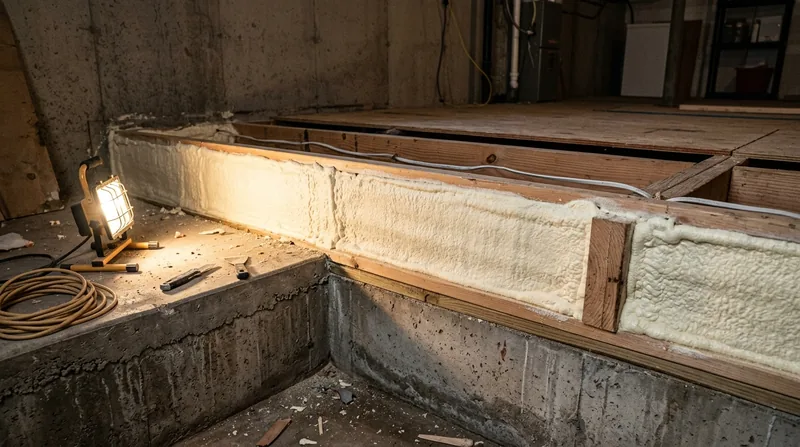




The rim joist and band joist in your Sioux Falls basement is where heated air leaks out and cold air infiltrates in winter, driving energy bills up and leaving frozen pipes as a real risk. These wood members run around the perimeter of your foundation, and when they are not sealed, they become a major path for stack effect to pull conditioned air upward and out of your home. Across Sioux Falls, Brandon, Tea, and Harrisburg, the long heating season and extreme temperature swings make this gap a priority. We seal and insulate the rim and band joist from inside the basement using closed cell or open cell spray foam, stopping drafts, protecting pipes, and recovering the energy you are losing at the foundation line. This is one of the highest-return insulation upgrades for any Sioux Falls homeowner, and it addresses the exact failure mode that dominates basement comfort across the region.
Why Rim Joist and Band Joist Sealing Matters in Sioux Falls
The rim joist runs cold because it is exposed to the outside air on three sides: the rim band itself sits at the outer edge of the foundation, and the joists that frame the first floor sit directly on top of it. In a Sioux Falls winter, that gap between the heated basement and the unheated rim space becomes a thermal bridge and an air leak route. The stack effect pulls warm basement air up and out through rim cavities, and at the same time, cold air from the rim space infiltrates back into the basement, chilling the walls and the pipes that run along them. A burst frozen pipe in winter can cost thousands in water damage and emergency repairs, and preventing that is worth the investment alone.
- Frozen pipes in the rim joist are common in Sioux Falls basements during January and February cold snaps, especially in older homes with uninsulated or poorly sealed rims.
- Cold basement walls radiate heat loss, making the basement feel uncomfortable and driving the furnace to run longer and harder.
- Air leakage at the rim joist contributes to the overall stack effect that pulls heated air out of your attic and upper floors.
- Sealing the rim stops drafts at the foundation line and stabilizes basement temperature year-round.
Addressing the rim joist is one of the fastest ways to improve basement comfort and protect your home's envelope in the IECC 6A climate that defines Greater Sioux Falls.
Key info: Homes in Sioux Falls, Harrisburg, and Tea often have full basements with rim joists running 30 to 50 linear feet. A single-story ranch with a basement rim might run 120 to 150 linear feet around the perimeter. Sealing that rim with closed cell foam creates a thermal break and stops the cold air path that freezes pipes and drives heating costs.
For more context on how rim joist sealing fits into a whole-home insulation strategy, see our attic spray foam insulation page, which addresses the stack effect from the top down.
South Dakota building code and local building departments in Sioux Falls govern the thermal barrier and ignition barrier requirements for spray foam in any basement application. Always confirm what applies at your address before work begins. For details on Sioux Falls permitting, contact the Sioux Falls Development Services office.
How We Seal and Insulate the Rim Joist in Sioux Falls
We access the rim joist from inside the basement, working from the foundation wall upward. The process starts with a site inspection to identify the joist cavity depth, any existing insulation or obstructions, and the linear footage we need to cover. We then prepare the surface, apply spray foam in controlled passes to the specified thickness, and finish with a thermal barrier if code requires it. The foam seals air leaks, fills voids in the joist cavity, and creates a continuous insulation layer that stops cold air from infiltrating and warm air from escaping.
- We inspect the basement rim joist and band joist to measure cavity depth and identify any moisture, existing insulation, or mechanical obstructions.
- We apply closed cell or open cell spray foam in multiple thin passes, controlling thickness and coverage to meet code and R-value targets.
- We maintain proper drum temperature and manufacturer ratio during application to ensure foam cures correctly and bonds to the substrate.
- We provide mechanical ventilation during and after application, with a re-entry window of 24 to 48 hours before you occupy the basement.
- We finish the foam with a thermal barrier if local code requires it, protecting the foam from ignition and meeting fire safety standards.
The entire process is designed to create a sealed, insulated rim joist that stops drafts and protects pipes without disrupting your basement layout or requiring structural work.
Local example: A 1970s ranch in south Sioux Falls with a basement rim joist running 140 linear feet and a cavity depth of 8 inches typically takes one day to seal and foam. We apply closed cell foam at 2 inches thick (R-12 to R-13) to stop air infiltration and provide a thermal break. The homeowner notices warmer basement walls, no draft at the rim, and stable basement temperature within a week of the job.
For a deeper look at closed cell versus open cell spray foam and when each is the right choice, visit our closed cell spray foam page.
Rim Joist Sealing Methods and Materials
| Method | Description | Best for |
|---|---|---|
| Closed Cell Spray Foam | High-density foam, R-6 per inch, moisture barrier, rigid once cured, requires thermal barrier per code. | Rim joists in basements where moisture control and thermal performance are both priorities; protects pipes in cold climates. |
| Open Cell Spray Foam | Lower-density foam, R-3.6 per inch, air seal only (not a moisture barrier), softer texture, requires thermal barrier per code. | Rim joists where budget is a concern and the joist cavity is deep enough for added thickness; does not control moisture. |
| Closed Cell at 1 to 2 Inches | Thin closed cell application, R-6 to R-13, seals air leaks and provides thermal break without excessive buildup. | Standard rim joist sealing in Sioux Falls basements; balances R-value, cost, and ease of thermal barrier installation. |
| Combination: Closed Cell + Fiberglass Batts | 1 inch of closed cell foam for air sealing and moisture control, then fiberglass batts for additional R-value if cavity allows. | Deeper rim joist cavities where R-value targets exceed what closed cell alone can deliver; reduces foam material cost. |
Rim Joist and Band Joist Spray Foam Cost in Sioux Falls: What to Expect
The cost of sealing and insulating a rim joist depends on the linear footage of rim, the cavity depth, the foam type (closed cell or open cell), and the thickness required to meet your R-value and code targets. A typical basement rim joist in Sioux Falls runs 100 to 150 linear feet, and closed cell spray foam sealing at 1 to 2 inches starts at around $650 to $1,200 for that scope. Open cell foam costs less per board foot but requires greater thickness to achieve the same R-value, so the total job cost may be similar or slightly lower depending on cavity depth and access.
- Linear footage of rim joist is the primary driver of cost, measured around the entire perimeter of your basement foundation.
- Cavity depth affects how much foam you need to reach your target R-value and whether you can use a thinner, closed cell application.
- Foam type (closed cell versus open cell) changes the price per board foot and the thickness required, so the total cost depends on both.
- Access to the rim joist from the basement, presence of obstructions like pipes or ducts, and any existing insulation to remove all factor into labor time and final cost.
- Thermal barrier installation, if required by code, adds material and labor but is a one-time cost that protects the foam.
The best way to know what a rim joist sealing job will cost for your home is to get a written estimate that specifies the linear footage, foam type, thickness, R-value, and any thermal barrier work. We provide free estimates within 24 hours and include all specs so you can compare quotes fairly. Call us at (605) 937-7766 or visit our pricing page for more detail on what factors move the cost up or down.
Rim Joist and Band Joist Spray Foam Near Me: What Sioux Falls Homeowners Should Know When Hiring
When you hire a spray foam insulation contractor for rim joist sealing, verify that the contractor is fully insured and can provide a certificate of insurance on request. Ask for a written estimate that includes the linear footage, foam type, thickness in inches, R-value per inch, and any thermal barrier work. Check references from recent projects in Sioux Falls, and ask about the contractor's re-entry timeline and ventilation plan during cure. Do not accept a quote without R-value and thickness specs, and do not allow re-entry to the basement until at least 24 hours after the foam is sprayed.
- Ask the contractor to confirm what code applies at your address by checking with the Sioux Falls building department before you commit.
- Verify that the contractor carries insurance and ask to see proof before work begins on your home.
- Get at least two estimates so you can compare scope, materials, R-value targets, and price fairly.
- Ask about the contractor's experience with rim joist sealing in Sioux Falls basements and request references you can contact.
- Confirm the re-entry window and ventilation plan in writing so you know when the basement is safe to occupy after the foam cures.
For a free estimate and to discuss your rim joist sealing project with a local contractor who knows Sioux Falls basements, contact us today.
Rim Joist & Band Joist Spray Foam in Sioux Falls: Pricing Guide
| Service | Price | Details |
|---|---|---|
| Rim joist sealing, closed cell, 1 to 2 inches | Starting at $650 | 100 to 150 linear feet of basement rim joist, closed cell foam for air sealing and thermal break, includes thermal barrier if code requires |
| Rim joist sealing, open cell, 3 to 4 inches | Starting at $700 | 100 to 150 linear feet of basement rim joist, open cell foam for air sealing, deeper cavity coverage, includes thermal barrier if code requires |
| Deeper rim cavity or additional insulation | Starting at $950 | More than 150 linear feet or cavity depth exceeding 8 inches, or combination of closed cell plus fiberglass batts for R-value targets |
| Obstruction removal and prep work | On estimate | Removal of existing insulation, rerouting of pipes or ducts, or surface prep that adds labor beyond standard application |
| Travel | Included | No separate charge for service calls within Sioux Falls and surrounding areas, all mileage is included in the estimate |
| Estimate | Free | Written estimate with R-value and thickness specs, response within 24 hours, no obligation to book |
Indicative pricing, the exact cost depends on square footage, finish, and site access. Free personalized estimate within 24h at (605) 937-7766.


