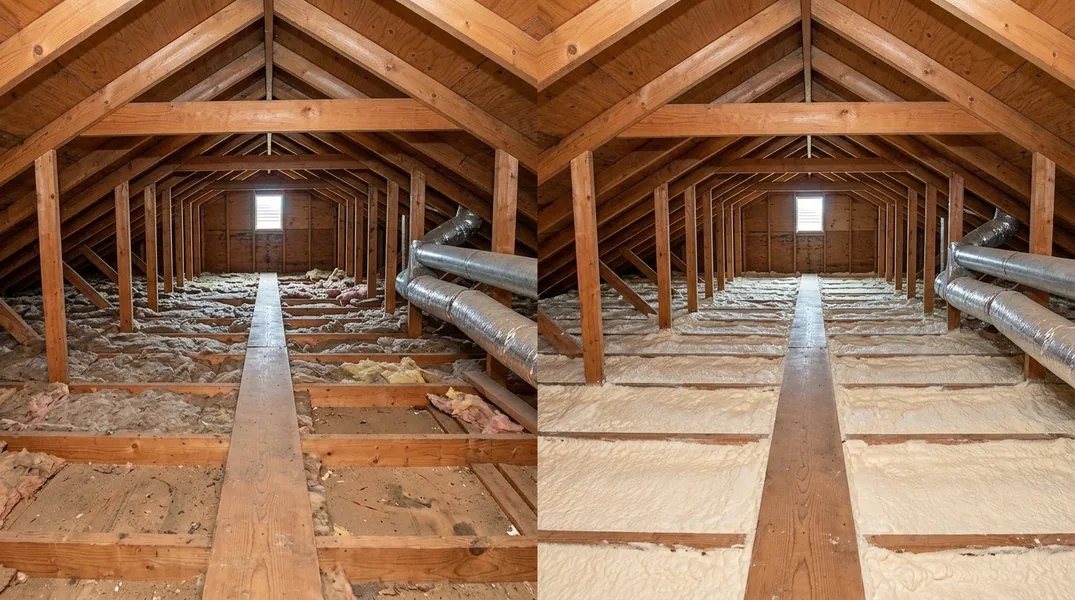
The Postwar Ranch Insulation Problem: Why Your Attic is Losing Effectiveness
If you own a postwar ranch home in Sioux Falls, you're likely familiar with one of the era's most persistent building challenges: inadequate attic insulation that has settled and flattened over decades. Built between the 1940s and 1970s, these charming single-story homes were often insulated with fiberglass batts or loose-fill materials that simply don't hold up to South Dakota's extreme temperature swings and heavy snow loads.
Over time, gravity, moisture, and seasonal expansion and contraction cause the original insulation to compress and settle. What once provided an R-value of R-19 or R-20 may now deliver only R-10 or R-12 in many areas of your attic. This compression means your heating and cooling systems work harder, your energy bills climb, and your home becomes less comfortable during our brutal winters and humid summers. The problem is compounded by air leaks around penetrations, ductwork, and the attic perimeter that the original builders simply didn't seal.
Spray Foam vs Blown In Insulation: Why Spray Foam Wins for Attics
When homeowners in Sioux Falls decide to upgrade their attic insulation, they quickly discover the comparison between spray foam and blown in insulation. While blown in insulation (typically cellulose or fiberglass) is less expensive upfront, spray foam delivers measurably superior performance in ways that matter for your home's long-term comfort and efficiency.
Attic Spray Foam Insulation creates a continuous thermal and air barrier across your entire attic floor, roof deck, and rim joists. Unlike blown in insulation, which settles and leaves gaps around framing members and mechanical penetrations, spray foam expands to fill every cavity and crevice. This means zero air infiltration at the attic level, which is critical in a climate like ours where temperature differentials can exceed 70 degrees Fahrenheit between inside and outside during winter.
Blown in insulation, by contrast, eventually settles by 10 to 20 percent, meaning the R-value you pay for today will diminish over the next 5 to 10 years. Spray foam does not settle. It maintains its rated R-value indefinitely, making it the best insulation for attic spaces where long-term performance matters. Additionally, spray foam prevents moisture infiltration and condensation issues that can plague blown in materials in humid climates or poorly ventilated attics.
Spray Foam vs Fiberglass: Performance and Longevity Compared
The comparison between spray foam and fiberglass is one we hear often from homeowners evaluating their options. Fiberglass batts, the standard insulation in most postwar ranches, have an R-value of approximately R-3.2 per inch. Spray foam, depending on the type, delivers R-6 to R-7 per inch. That means you achieve the same thermal resistance with roughly half the material thickness, which is invaluable in attics with limited headroom.
Fiberglass is also vulnerable to moisture absorption. If your attic experiences any condensation or minor roof leaks, fiberglass batts can trap moisture, leading to mold growth, rot, and a decline in insulation effectiveness. Closed Cell Spray Foam Insulation, the preferred choice for attics, is moisture-resistant and actually helps prevent water intrusion by creating a vapor-tight seal. Over a 20 to 30-year lifespan, this difference translates to fewer repairs, better air quality, and more stable energy bills.
Fiberglass also requires proper installation with air gaps minimized, which is difficult to achieve consistently across an entire attic. Spray foam application is more forgiving because the material itself seals gaps that would otherwise be missed. For homeowners in Sioux Falls seeking a permanent solution to attic insulation problems, spray foam offers reliability that fiberglass simply cannot match.
Spray Foam vs Cellulose: Why Cellulose Falls Short in Cold Climates
Cellulose is often marketed as an eco-friendly and affordable insulation option, and it does have legitimate advantages in certain applications. However, spray foam vs cellulose is a particularly important comparison for homeowners in cold, snowy regions like South Dakota. Cellulose is made from recycled paper and treated with fire retardants, and while it has a decent R-value of approximately R-3.6 per inch, it shares critical weaknesses with fiberglass when installed in attics.
Cellulose is hygroscopic, meaning it absorbs and releases moisture based on relative humidity. In an attic with seasonal temperature and humidity fluctuations, cellulose can absorb moisture, swell, and eventually settle. This settling is more pronounced than with fiberglass because cellulose is denser. Additionally, cellulose requires careful air sealing around all penetrations before installation, because the material itself provides no air barrier. If your attic has any air leaks after cellulose installation, warm, moist air from your living space will bypass the insulation and create condensation on the roof deck, potentially causing ice dams in winter.
Spray foam eliminates these concerns entirely. It provides both insulation and air sealing in a single application, does not absorb moisture, and will not settle or degrade over time. For the cold climate challenges specific to Sioux Falls, spray foam is the most reliable long-term investment.
Best Insulation for Attic: Why Spray Foam is the Superior Choice
When evaluating the best insulation for attic applications, the decision ultimately comes down to your priorities: upfront cost, long-term performance, durability, and climate appropriateness. While blown in insulation, fiberglass, and cellulose all cost less initially than spray foam, they all share a critical limitation: they provide insulation only, not air sealing. In an attic, air leakage is often the bigger problem than inadequate R-value alone.
Spray foam addresses both issues simultaneously. Open Cell Spray Foam Insulation is slightly less expensive than closed cell and works well for interior attics where vapor permeability is desirable. Closed cell spray foam is denser, provides a vapor barrier, and is ideal for attics in older homes where moisture control is critical. Both types eliminate air infiltration, prevent settling, resist moisture, and maintain their R-value for the life of your home.
The energy savings alone often justify the higher upfront investment. Most homeowners see a 15 to 30 percent reduction in heating and cooling costs after spray foam attic insulation, which translates to payback within 7 to 10 years. After that, you're simply enjoying lower bills and a more comfortable home. For the best insulation for attic spaces in our climate, spray foam is unquestionably the superior choice.
Attic Spray Foam Insulation Cost in Sioux Falls: What to Budget
Understanding spray foam pricing is essential for making an informed decision. Spray foam typically costs between 1.50 and 2.50 dollars per board foot, depending on the type (open cell or closed cell), the complexity of your attic, and the thickness required to meet current building codes and energy efficiency goals. For a typical 1,200 to 1,500 square foot ranch attic, you can expect a total investment of 3,500 to 6,000 dollars.
This is significantly more than blown in insulation, which might cost 1,000 to 2,000 dollars for the same space. However, the comparison is misleading because blown in insulation will settle and lose effectiveness, while spray foam will not. Over 20 years, the true cost per year of spray foam is often lower than alternatives when you account for energy savings and the absence of future upgrades or repairs.
Many homeowners also qualify for federal energy tax credits when they upgrade to spray foam insulation. Additionally, the improved comfort, better moisture control, and potential reduction in mold or ice dam problems often deliver value beyond what the energy savings alone suggest. To get an accurate quote for your specific home and attic configuration, contact Sioux Falls Spray Foam Insulation at (605) 937-7766 or request a free estimate today. We'll assess your current insulation, discuss your goals, and provide transparent pricing with no hidden fees.
Looking for a professional spray foam insulation contractor in Sioux Falls? Sioux Falls Spray Foam Insulation responds fast for all your spray foam insulation needs.
Get a Free Quote